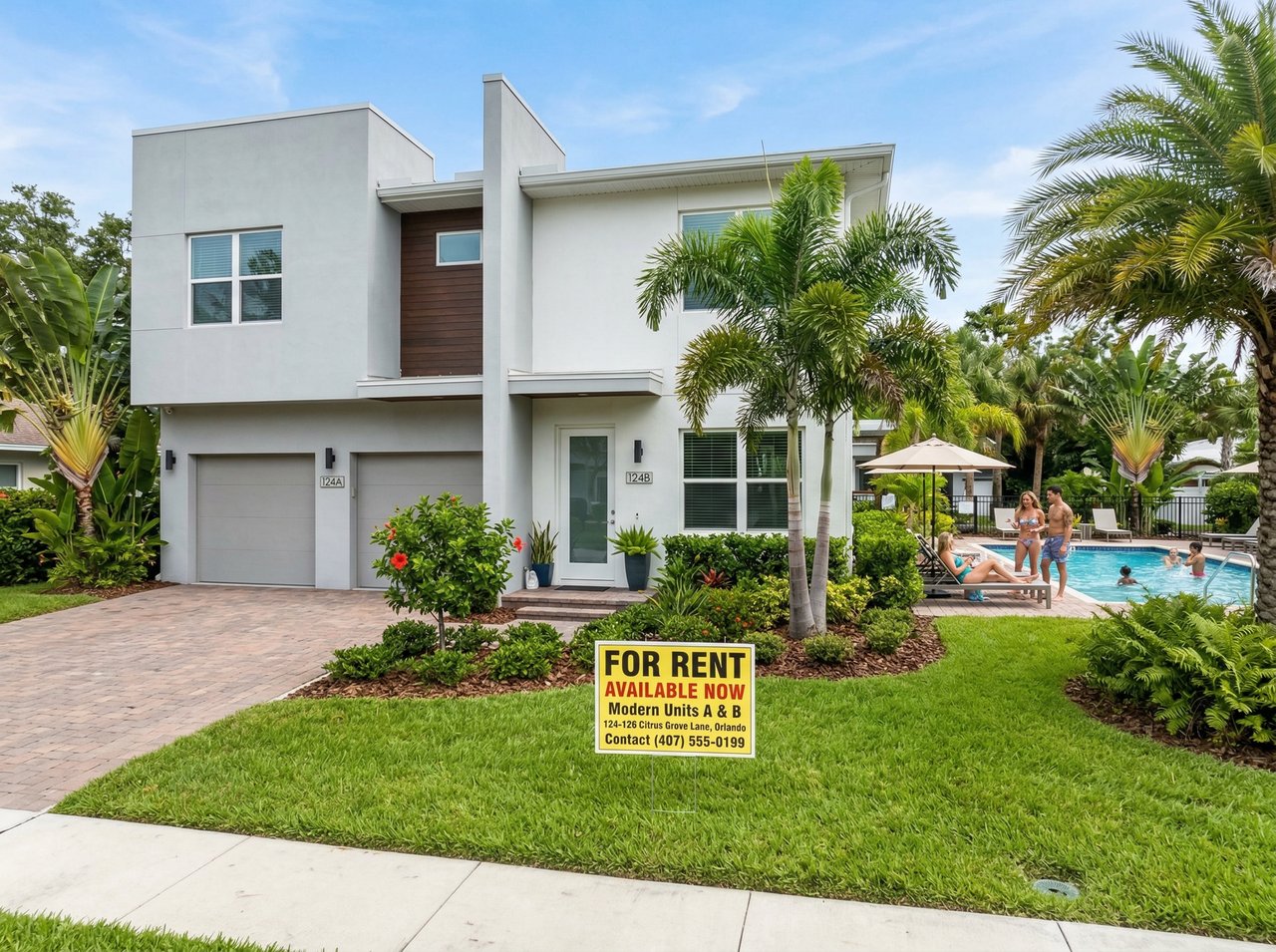
Orlando remains one of the most compelling rental markets in the Southeast. With 75 million annual visitors, the second-fastest net in-migration of any major U.S. metro in 2025, and a diversified employer base spanning tourism, healthcare, and defense, the fundamentals that drive rental demand are not going away. In 2026, multifamily cap rates range from 5.0% to 5.5%, single-family long-term rental yields run roughly 5% to 6% of home value annually, and short-term vacation rentals near Disney World generate median revenues around $52,000 per year in Kissimmee. Whether you are buying your first income property or adding to an existing portfolio, this guide covers what you actually need to know: neighborhood-by-neighborhood returns, Airbnb regulations by county, cash flow modeling, Florida landlord law updates, property management costs, and exit strategies including the 1031 exchange.
| Metric | 2026 Figure |
|---|---|
| Orlando metro median home price | ~$400,000 |
| Median 3BR rent (single-family) | $2,100 to $2,400/month |
| Multifamily cap rates | 5.0% to 5.5% |
| Single-family net yield (cap rate) | 3.2% to 4.0% (modeled) |
| Apartment vacancy rate | ~8.9% (stabilizing) |
| Rent growth projection (2026) | +1.2% (multifamily) |
| Kissimmee STR median annual revenue | ~$52,000 |
| Kissimmee STR occupancy rate | ~69% |
| Orange County property tax (effective) | ~0.75% |
| Osceola County property tax (effective) | ~0.85% |
| Property management fee range | 8% to 12% of collected rent |
| 30-year fixed mortgage rate (March 2026) | ~6.06% |
Is Orlando a Good Market for Rental Property Investment in 2026?
Yes, with realistic expectations. Orlando is not a market that throws off large monthly cash flows at current purchase prices and interest rates. The math is honest: a $350,000 starter home renting for $2,475 per month produces a modeled net operating income of roughly $12,700 after vacancy reserves, management fees, insurance, taxes, maintenance, and CapEx, yielding a cap rate near 3.6%. That is a total-return thesis, not a pure cash-flow play. What Orlando does offer is reliable demand, moderate appreciation (2% to 5% annually is the current forecast), population growth that consistently outpaces national averages, no state income tax, and access to both long-term and short-term rental strategies that few other metro areas can match simultaneously.
The market normalized sharply in 2025 after the pandemic-era rent surge. Median asking rents declined roughly 1.8% year-over-year by late 2025, and multifamily vacancy settled around 8.9%. That softness is working itself through the system. According to the Marcus & Millichap 2026 Orlando Multifamily Market Report, vacancy is poised to tighten in 2026 for a third consecutive year, and the volume of new units under construction by late 2025 fell to its lowest level since 2020. The pipeline of new supply is shrinking. That sets up improving fundamentals for investors who are buying now.
What Are the Best Orlando Neighborhoods for Rental Investment?
The right neighborhood depends on your strategy. Long-term rentals perform differently than short-term vacation rentals, and your budget shapes the options. Here is how the major investment submarkets break down in 2026.
Kissimmee and Osceola County
Kissimmee is the epicenter of the Orlando vacation rental market. Proximity to Walt Disney World, Universal Studios, and SeaWorld drives year-round tourism demand. According to Airbtics data through early 2026, a typical short-term rental in Kissimmee generates median annual revenue of approximately $52,000, with a 69% occupancy rate and an average daily rate of $201. Top-performing properties with pool access, resort amenities, and professional management can push well above $70,000 per year. Entry prices for 3- to 4-bedroom homes suitable for vacation rental range from $300,000 to $380,000 in most of Kissimmee, making the math more accessible than in many competing Florida markets. For long-term rentals, Kissimmee delivers solid tenant demand from tourism and service-industry workers who prefer affordable suburban living, and HUD Fair Market Rents for the Orlando-Kissimmee-Sanford metro set the 3-bedroom benchmark at $2,476 per month for FY 2026.
Hunters Creek, a master-planned community within the Kissimmee corridor, leads the submarket for Airbnb performance: $45,076 in average annual revenue and a 78% occupancy rate, according to FunStay Florida. One important caveat: StaySTRA data flags Kissimmee as one of the most saturated vacation rental markets in America, with roughly 36,888 active listings. Average monthly revenue across all listings sits at about $3,603, which is challenging at today's purchase prices. The gap between median and top-quartile performance is wide. Differentiation through property quality, amenities (private pool, game room, home theater), and professional dynamic pricing is the difference between a profitable asset and a break-even one.
St. Cloud
St. Cloud sits immediately east of Kissimmee and offers lower entry prices, typically in the $320,000 to $400,000 range, with strong long-term rental demand from families priced out of more expensive submarkets. It benefits from the same employment base as Kissimmee and is seeing new construction activity that is attracting a broader tenant mix. For short-term rentals, AirROI 2026 data shows St. Cloud generating an average of $12,396 in annual STR revenue at a 38% occupancy rate, which is significantly below Kissimmee's performance. The city also enforces strict zoning for STRs, limiting them to hotel and motel zones. Investors targeting St. Cloud should plan for long-term rental strategy rather than Airbnb.
Horizon West
Horizon West in western Orange County has been one of Central Florida's fastest-growing master-planned communities for over a decade. The area appeals to families with high incomes, strong schools, and resort-style community amenities. Median home prices in early 2026 sit around $550,000, with new construction from Pulte and Lennar ranging from $480,000 to $620,000, according to Florida Homes Group. Long-term rental demand is solid, particularly for well-appointed 4- and 5-bedroom homes serving families relocating for employment at Disney, Lockheed Martin, AdventHealth, or nearby tech campuses. The higher purchase prices compress cash flow in the near term, but appreciation has run 5% annually and tenant quality in this submarket tends to be excellent. New-construction properties here also carry CDD fees typically in the $1,500 to $3,000 per year range, which you must factor into your expense underwriting. Read more about how those fees work in our guide to CDD fees in Orlando.
Lake Nona
Lake Nona is a medical city in southeastern Orange County anchored by the VA Medical Center, UCF College of Medicine, Nemours Children's Hospital, and multiple biotech employers. Median home prices range from $450,000 to $600,000, and the tenant pool skews toward healthcare and tech professionals with above-median incomes. Long-term rental demand is consistent, vacancy is low, and the submarket is less susceptible to the seasonal fluctuations that affect tourist corridors. According to Orlando Rent's 2026 tenant demographics analysis, Lake Nona is among the suburban communities seeing the strongest rental demand due to new development and lifestyle-focused amenities. The trade-off is higher purchase prices that push gross rent yields below 6% in most cases. This is a long-hold appreciation and stability play more than a yield play.
Downtown Orlando and College Park
Condos in the $300,000 to $500,000 range and single-family homes from $400,000 to $700,000 characterize the urban core. Vacancy in the CBD and northwest Orlando saw some of 2025's largest declines and faces limited new supply pressure heading into 2026, per the Marcus & Millichap report. Urban renters, young professionals, and remote workers drive demand here. Short-term rental regulations in the City of Orlando proper are restrictive: entire-home rentals in residential zones are not permitted unless the owner lives on-site at least 51% of the year. Investors buying inside city limits should plan for long-term tenants.
Long-Term vs. Short-Term Rentals: Which Strategy Makes More Sense?
Both strategies have a place in Orlando, but they serve different investor profiles and come with fundamentally different operating demands.
Long-term rentals offer predictable monthly income, lower operating costs, and simpler management. A 3-bedroom home renting for $2,200 per month generates $26,400 in gross annual rent. After property management (8% to 10%), vacancy reserve (5%), maintenance and CapEx reserves (roughly 10% combined), taxes, and insurance, you are looking at net operating income in the $12,000 to $15,000 range on a $350,000 to $420,000 purchase. That produces a cap rate of 3.2% to 4.0%, consistent with what detailed underwriting from Ackley Property Management's 2026 analysis confirms. Cash-on-cash returns improve if you buy with larger down payments or find below-market properties.
Short-term vacation rentals in the right location can produce significantly higher gross revenues: a well-managed 4-bedroom home near Disney in Kissimmee targeting $250 per night at 70% occupancy generates approximately $63,875 in gross annual income before expenses. Operating costs are considerably higher for STRs: property management fees typically run 20% to 30% of revenue for full-service vacation rental managers, plus cleaning costs, supplies, platform fees, and higher insurance and maintenance. Net yields on well-run STRs near Disney can still exceed long-term rental net yields by 30% to 50%, but performance is far more variable. Competition is intense. You need a differentiated property, professional management, and dynamic pricing to achieve top-quartile results.
| Strategy | Typical Gross Revenue | Management Complexity | Cap Rate Range | Best Locations |
|---|---|---|---|---|
| Long-term rental (LTR) | $26,400 to $37,200/yr (3-4BR) | Lower | 3.2% to 4.0% | Lake Nona, Horizon West, St. Cloud |
| Short-term rental (STR) | $38,000 to $70,000+/yr (3-4BR near Disney) | Higher | 4.0% to 7%+ (top performers) | Kissimmee, Celebration, Disney corridors |
| Multifamily (5+ units) | Varies by unit mix | Moderate to high | 5.0% to 5.8% | Urban core, suburban growth corridors |
What Are the Airbnb and Short-Term Rental Rules in Orlando?
Regulations differ significantly depending on which jurisdiction your property falls in. This is one of the most important due diligence items before purchasing any property intended for short-term rental use.
City of Orlando (Orange County, incorporated)
The City of Orlando has the most restrictive STR rules in the region. Entire-home rentals in residential zones are generally prohibited unless the owner lives on-site for at least 51% of the year, making it a home-sharing market rather than an investor vacation rental market. If you want to host guests in a room while you live there, you must register at orlando.gov, pay a $275 initial fee ($125 annual renewal), obtain a DBPR vacation rental license, and comply with an occupancy limit of 2 guests per bedroom plus 2 extra (maximum 4 total). Quiet hours are 10 PM to 7 AM, and violations carry fines of $250 per day up to $5,000. These rules effectively eliminate the pure-investor Airbnb play inside city limits.
Unincorporated Orange County
Unincorporated Orange County is more investor-friendly. Entire-home rentals are permitted in residential and commercial zones, though not in accessory dwelling units. You must apply for an STR permit through orangecountyfl.net, pay a $63 application fee (valid 2 years), and provide a floor plan, lease sample, proof of ownership, and an STR use letter. Occupancy limits mirror the city: 2 guests per bedroom plus 2 extra, with 1 vehicle per bedroom and 2 required off-street parking spots. The combined tax obligation is 12.5%: 6% Florida Sales Tax, 0.5% County Surtax, and 6% Tourist Development Tax. Two violations result in a 1-year STR ban at that address. Enforcement is complaint-driven, per FunStay Florida's 2025 regulatory guide.
Osceola County (Kissimmee, St. Cloud)
Osceola County is the heart of the Central Florida vacation rental market and has a more developed regulatory framework. STRs are only permitted in designated STR Overlay Districts or STRPD (Short Term Rental Planned Development) zones, typically located near Disney, Universal, and established tourist corridors. You must obtain an Osceola County STR license, which requires: completed application, proof of ownership, government-issued ID, detailed floor plan, proof of $1,000,000 liability insurance, notarized compliance affidavit, and payment of a $160 inspection fee plus $250 license fee. The annual renewal is $150. Processing takes 2 to 4 weeks. You must also obtain a state DBPR vacation rental license for approximately $170 per year.
Tax obligations in Osceola total 13.5%: 6% Florida State Sales Tax, 6% Osceola Tourist Development Tax, and 1.5% Discretionary Surtax. Critically, the 6% Osceola Tourist Development Tax is not automatically collected by Airbnb or VRBO: you must collect it from guests and remit it to the county by the 20th of each month. Occupancy limits are 3 guests per bedroom plus 2 additional guests, and hosts must maintain a guest registry for 3 years. Kissimmee itself is generally more lenient in enforcement than unincorporated Osceola, while St. Cloud restricts STRs almost entirely to hotel and motel zones. Always verify zoning before purchasing: a property outside approved overlay districts cannot legally operate as a short-term rental, regardless of whether you complete all other licensing steps.
How Do You Calculate Cash Flow and ROI on an Orlando Rental Property?
Real estate investors use several metrics to evaluate income properties. Here is how each applies to Orlando in 2026.
Gross Rent Multiplier (GRM): Divide purchase price by annual gross rent. A $380,000 home renting for $2,200 per month ($26,400/year) has a GRM of 14.4. Lower is better. In most Orlando submarkets, GRMs fall between 12 and 16 for single-family homes.
Cap Rate: Net operating income divided by purchase price, expressed as a percentage. NOI equals gross rent minus all operating expenses excluding mortgage debt service. For a $420,000 4-bedroom home at $2,925/month in rent, with modeled annual operating expenses of approximately $18,300 (vacancy, management, maintenance, CapEx, taxes, insurance), NOI is roughly $15,100 and the cap rate is 3.6%. Multifamily properties trade at higher cap rates: suburban Class A at 5.25%, suburban Class B at 5.38%, and value-add acquisitions at 6.77%, per Apartment Loan Store's March 2026 cap rate data.
Cash-on-Cash Return: Annual pre-tax cash flow divided by total cash invested (down payment plus closing costs plus initial repairs). If you put 25% down on a $380,000 property ($95,000), closing costs run $7,500, and your annual mortgage payment (at 6.06%) is approximately $20,400, your pre-tax cash flow after all expenses might be negative $2,000 to positive $3,000 depending on exact expenses. Cash-on-cash returns in the Orlando market at current prices and rates are thin, often 0% to 3%, unless you find a discounted acquisition or structure with a larger down payment.
Total Return: Add appreciation, principal paydown, and tax benefits to your cash-on-cash calculation. With 2% to 5% annual appreciation on a $400,000 property, you are building $8,000 to $20,000 per year in equity through appreciation alone. Factor in principal reduction from monthly mortgage payments (roughly $4,000 to $6,000 annually in the early years), depreciation deductions, and the mortgage interest deduction, and total returns are meaningfully more attractive than cash flow alone suggests. Orlando works best as a medium-to-long-hold investment, not a short-term yield vehicle.
What Are the Florida Landlord-Tenant Laws That Rental Investors Must Know?
Florida's landlord-tenant laws are relatively landlord-friendly compared to many states, and they were updated in 2025 and 2026 with several changes investors should know.
New for 2026 (Senate Bill 716): Effective July 2026, the notice period for non-payment of rent increases from 3 days to 5 days (excluding weekends and legal holidays). This extends eviction timelines and increases holding costs during non-payment disputes, per Kanga Property Management's 2026 law update.
Electronic notices: Since July 1, 2025, landlords may deliver legally required written notices by email if the tenant has provided written consent and a designated email address. You must keep proof of transmission and be able to demonstrate delivery.
Flood disclosures (required from early 2026): All lease agreements of one year or longer must include information about the property's flood zone, flood history, and insurance and evacuation procedures, per Florida lease law updates effective 2025.
Security deposits: Landlords must disclose the location of the security deposit within 30 days of receiving it. The claim timeline is 15 days for itemized deductions or 30 days for returning the deposit in full. Missing the 30-day deadline forfeits the right to claim against the deposit.
Month-to-month termination: At least 30 days written notice is required by either party to terminate a month-to-month tenancy.
Landlord entry: Florida requires reasonable notice before entering a rental unit. The general standard is 12 hours for non-emergency situations.
Rent increases: Florida preempts local rent control ordinances statewide. There are no caps on how much you can raise rent between lease terms, though proper notice periods apply.
Florida does not require landlords to accept Section 8 Housing Choice Vouchers statewide, though Bahia Property Management notes that pending federal legislation could change this. The Orlando Housing Authority manages approximately 4,600 vouchers, 600 of which are project-based. HUD increased Fair Market Rent levels across Florida for FY 2025 and FY 2026, making Section 8 participation increasingly viable for landlords in affordable-to-mid-tier rental segments, as the payment standards have kept closer pace with actual market rents.
What Do Property Management Companies Charge in Orlando?
Professional property management is the difference between a passive investment and a second job. Orlando is a transient market with a large tourism workforce, which increases tenant turnover relative to more stable metro areas. For most out-of-state or portfolio investors, professional management is non-optional.
Standard fees in Orlando for long-term rental management, per JAG Property Management's 2025 investor guide and confirmed by multiple sources:
- Monthly management fee: 8% to 12% of collected rent. On a $2,200/month property, that is $176 to $264 per month, or $2,112 to $3,168 per year.
- Tenant placement / leasing fee: 50% to 100% of one month's rent, charged once at placement. This covers marketing, showings, screening, and lease preparation.
- Lease renewal fee: $0 to $300 flat, depending on the company. Many Orlando managers do not charge this separately.
- Maintenance markup: 0% to 20% added to vendor invoices. Ask this question explicitly before signing a management agreement.
- Setup / onboarding fee: $250 to $500, often waived.
- Eviction fee: $800 to $1,500 plus legal costs.
Short-term rental management in Kissimmee and the Disney corridor is more expensive, typically 20% to 30% of gross revenue, because of the operational intensity: guest communication, cleaning coordination between stays, supply restocking, dynamic pricing management, and multi-platform listing maintenance.
When evaluating managers, focus on whether the fee is applied to collected rent (not gross lease value), whether maintenance markups are disclosed, and whether there is an early termination penalty. A reputable local manager more than earns their fee through reduced vacancy and better tenant selection. If you are ready to explore Orlando investment properties, browse current available listings on serhantorlando.com.
What Is a 1031 Exchange and How Does It Help Orlando Investors?
A 1031 exchange is one of the most powerful wealth-building tools available to real estate investors. Under IRS Section 1031, when you sell an investment property, you can defer federal capital gains taxes by reinvesting the proceeds into another "like-kind" property of equal or greater value. Florida's lack of a state income tax makes this even more advantageous: you are only deferring federal tax, and there is no state capital gains tax to contend with.
The rules are strict and non-negotiable, per KLR's 2026 guide to 1031 exchanges:
- 45-day identification rule: From the date you close on your relinquished property, you have exactly 45 calendar days to identify potential replacement properties in writing to your Qualified Intermediary (QI). There are no extensions.
- 180-day closing rule: You must close on the replacement property within 180 days of selling the original, or by the due date of your tax return (including extensions), whichever is earlier.
- Qualified Intermediary required: You cannot touch the sale proceeds. A QI holds the funds and facilitates the exchange. Choosing a financially sound, reputable QI is critical: QI insolvency has destroyed exchanges in the past.
- Equal or greater value: To defer 100% of capital gains, the replacement property must be equal or greater in both value and debt assumed. Receiving any cash back (called "boot") triggers tax on that amount.
- Like-kind property only: All real property held for investment qualifies. You can exchange a Kissimmee vacation rental for a Lake Nona long-term rental, or a single-family home for a small apartment building.
- Investment use only: Properties held primarily for sale (flips) do not qualify.
For Orlando investors building long-term portfolios, the 1031 exchange is the primary mechanism for upgrading from one property type to another, consolidating multiple properties into a larger asset, or repositioning from vacation rental to long-term rental without triggering a taxable event. Always engage a CPA and a qualified intermediary before initiating a sale. The exchange must be structured before you close on the sale, not after.
How Does New Construction Factor Into Orlando Rental Investment?
New construction in Horizon West, Lake Nona, St. Cloud, and Osceola County continues to deliver investor-grade opportunities. Purpose-built rental communities are expanding, and individual investors can purchase new-construction homes from Pulte, Lennar, Meritage, and DR Horton with builder incentives including rate buydowns and closing cost contributions that meaningfully improve initial cash flow. New construction also eliminates deferred maintenance concerns in the first 5 to 10 years, reducing CapEx reserves. The trade-off is higher purchase prices and, in many planned communities, CDD fees and HOA restrictions that may limit short-term rental use. Always review HOA governing documents before assuming a new-construction home is eligible for Airbnb.
Orlando's city government has an active pipeline: as of August 2025, 9,200 units were under construction citywide, with 18,000 more approved or in permit review and zoning in place for 44,000 units under the Orlando Unlocked housing initiative. That supply will continue to put moderate pressure on rent growth in the near term, which is already reflected in the 1.2% projected rent increase for 2026. By 2027 and 2028, as the pipeline shrinks and in-migration continues, the rent trajectory should improve. Explore current new construction opportunities in Central Florida for inventory across these submarkets.
What Is the Rental Market Outlook for Orlando in 2026 and Beyond?
The near-term picture is one of stabilization after a period of excess supply. Vacancy in the multifamily sector is holding around 8.9%, and rents are projected to rise just 1.2% in 2026. But the longer arc is favorable. Orlando's population growth is underpinned by net in-migration that ranked second-fastest among major U.S. metros in 2025. Major job-creating employers continue to expand: Disney, AdventHealth, UCF Health, and Lockheed Martin are all adding headcount. The theme park economy generates 75 million annual visitors who support a permanent hospitality and service workforce that needs housing. Transaction volume in the investment sales market jumped 56% year-over-year in 2025, signaling renewed institutional and individual investor confidence, per Northmarq's January 2026 Orlando multifamily report.
The most important risk to monitor in 2026 is affordability. Orlando was recently ranked the 7th least affordable U.S. city for renters relative to incomes. Even with the state's minimum wage rising to $15 per hour by September 2026, two full-time minimum-wage earners can only comfortably afford approximately $1,550 per month in rent, well below the $1,800 to $1,900 median. This affordability gap constrains rent growth in the entry-level segment and supports demand for the Section 8 voucher program. Landlords with units in the $1,400 to $1,700 range can reduce vacancy risk by participating in the Housing Choice Voucher program, which provides guaranteed payment from the Orlando Housing Authority on the subsidy portion. For a deeper look at where the overall Orlando market is heading, see our 2026 Orlando real estate market forecast.
Frequently Asked Questions
What is a good cap rate for rental property in Orlando?
For single-family homes in Orlando in 2026, modeled cap rates after all operating expenses fall in the 3.2% to 4.0% range. Multifamily properties trade at higher cap rates, from 5.0% to 5.5% for Class A and B suburban assets and up to 6.77% for value-add acquisitions. Orlando investment is typically a total-return play combining yield, appreciation, and principal paydown rather than a pure yield play.
Can you run an Airbnb in Kissimmee?
Yes, but only if the property is located within a designated STR Overlay District or STRPD zone, which are typically in tourist corridors near Disney. You must obtain an Osceola County STR license ($160 inspection fee plus $250 license fee, renewed annually at $150), a state DBPR vacation rental license, $1,000,000 in liability insurance, and register to collect the combined 13.5% in taxes. Always verify zoning before purchasing.
How much does an Airbnb near Disney World make per year?
In Kissimmee, the median annual Airbnb revenue across all listings is approximately $52,000, with an average daily rate of $201 and a 69% occupancy rate. Top-performing properties with private pools, resort amenities, and professional management can exceed $70,000 to $90,000 per year. Entry-level and poorly managed properties fall significantly below the median.
What are property management fees in Orlando?
Long-term rental managers in Orlando charge 8% to 12% of collected monthly rent, plus a tenant placement fee of 50% to 100% of one month's rent for finding a new tenant. Short-term vacation rental managers typically charge 20% to 30% of gross revenue due to higher operational demands. Always ask whether maintenance markups and early termination fees apply.
What is a 1031 exchange and can Florida investors use it?
A 1031 exchange allows investment property owners to defer federal capital gains taxes by selling one property and reinvesting the proceeds into a like-kind replacement property of equal or greater value. You have 45 days to identify the replacement property and 180 days to close. Florida has no state income tax, so only federal gains are deferred, making the 1031 exchange especially advantageous for Florida investors. A Qualified Intermediary must hold the proceeds throughout the exchange.
What is the vacancy rate for Orlando rental properties?
The Orlando multifamily vacancy rate is approximately 8.9% through 2026, down from higher levels and poised to tighten further as new construction slows. For single-family rental properties under professional management, effective occupancy typically runs 94% to 95%, meaning roughly 3 weeks of vacancy per year on average.
Is it better to invest in long-term or short-term rentals in Orlando?
Long-term rentals offer lower operating costs, simpler management, and more predictable income, with cap rates of 3.2% to 4.0% on single-family homes. Short-term rentals near Disney can generate 30% to 50% more net income when well-managed, but carry higher operating costs, heavier competition, and meaningful regulatory and zoning constraints. The right strategy depends on your property location, risk tolerance, and involvement level.
What are the new Florida landlord-tenant law changes for 2026?
Senate Bill 716, effective July 2026, extends the non-payment notice period from 3 days to 5 days before an eviction can be filed. Flood disclosures are now required in all residential lease agreements of one year or more. Email notice delivery has been permitted since July 2025 if the tenant has provided written consent. Florida preempts local rent control ordinances statewide.
Investing in Orlando rental property requires honest underwriting, current knowledge of local regulations, and a clear-eyed view of which strategy fits your neighborhood. The market is not the same in every zip code, and the difference between a break-even property and a profitable one often comes down to pre-purchase due diligence. If you are evaluating specific properties or want to understand which submarkets align with your investment criteria, reach out to the SERHANT. Orlando team. We work across Orange, Osceola, Lake, and Seminole counties and can help you analyze acquisition targets before you commit.


