Orlando is now the fastest-growing major metro in the United States, adding 284,300 new residents since the 2020 Census according to the Orlando Economic Partnership. If you are moving to Orlando from New York, the math alone makes the case: a household earning $200,000 will save roughly $53,000 per year between eliminated state and city income taxes, lower housing costs, and dramatically cheaper childcare. But the real question is not whether to move. It is where to land when you get here.
This guide maps New York City neighborhoods to their Orlando equivalents, with real median home prices, commute times, school ratings, and line-item cost comparisons sourced from ORRA, Redfin, Numbeo, and the U.S. Census Bureau. No vague advice. No generic listicles. Just the data and local knowledge that only someone who sells homes across Central Florida every day can provide.
How Much Will You Actually Save Moving from NYC to Orlando?
A New York City household earning $200,000 will save approximately $53,578 per year by relocating to Orlando. That figure comes from five categories: housing, taxes, childcare, dining, and daily expenses. Here is the full breakdown.
The Tax Savings Are Immediate
Florida has no state income tax. New York charges both state and city income tax for NYC residents. The savings scale with income.
| Gross Income | NYS Tax | NYC Tax | Total NY Tax Burden | Annual Savings in Florida |
|---|---|---|---|---|
| $150,000 | $8,015 | $5,340 | $13,355 | $13,355 |
| $200,000 | $10,815 | $7,280 | $18,095 | $18,095 |
| $300,000 | $17,615 | $11,160 | $28,775 | $28,775 |
Source: New York State Department of Taxation and Finance 2025 tax tables, NYC Comptroller tax rate schedule. Calculations assume single filer, standard deduction.
For a dual-income household earning $300,000 combined, that is roughly $25,000 to $29,000 back in pocket from day one. No lifestyle change required.
Housing: Own for Less Than You Rent
The median home price in the Orlando metro area is $388,500 as of March 2026, according to the Orlando Regional REALTOR Association (ORRA). Single-family homes sit at a $440,000 median. Condos come in at $196,500.
| Housing Scenario | NYC Cost (Monthly) | Orlando Cost (Monthly) | Annual Difference |
|---|---|---|---|
| 1-bedroom apartment (rent) vs. $440K home (own) | $3,800 rent | $2,790 mortgage (PITI) | $12,120 saved |
| 2-bedroom apartment (rent) vs. $440K home (own) | $5,500 rent | $2,790 mortgage (PITI) | $32,520 saved |
| Manhattan 1-bedroom (rent) vs. $440K home (own) | $5,242 rent | $2,790 mortgage (PITI) | $29,424 saved |
Sources: Zumper and RentCafe NYC rent data (2026), ORRA March 2026 market report. Orlando mortgage calculated at 6.46% (Freddie Mac April 2026 average), 20% down, 30-year fixed, including property taxes and insurance.
The critical difference: in NYC, $3,800 per month buys you a lease. In Orlando, $2,790 per month buys you a home and builds equity every single month.
The Full Annual Savings Picture
| Category | NYC Annual Cost | Orlando Annual Cost | Savings |
|---|---|---|---|
| Housing (rent vs. own) | $45,600 | $33,480 | $12,120 |
| State and City Income Tax ($200K) | $18,095 | $0 | $18,095 |
| Childcare (1 infant, full-time) | $29,400 | $13,464 | $15,936 |
| Dining out (2x/week, mid-range) | $14,560 | $8,840 | $5,720 |
| Gym (2 memberships) | $2,875 | $1,168 | $1,707 |
| Total | $110,530 | $56,952 | $53,578 |
Sources: Numbeo.com NYC vs. Orlando comparison (March 2026), Care.com and TooTris childcare cost data, Expatistan dining comparisons.
That $53,578 is conservative. It does not include savings on groceries (27% less for eggs, 21% less for chicken per Numbeo), transportation, or the homestead exemption Florida offers on primary residences, which reduces your assessed property value by up to $50,000.
The NYC-to-Orlando Neighborhood Map
Every New Yorker asks the same question: "Where should I live?" The answer depends on what you love about your current neighborhood. Here is how the best Orlando neighborhoods map to their NYC equivalents, with real prices.
Winter Park = Upper West Side
Winter Park is Orlando's most established, walkable neighborhood. Tree-lined streets, independent boutiques on Park Avenue, sidewalk dining, and SunRail commuter rail access make this the closest thing to an Upper West Side lifestyle in Central Florida.
Median home price: $590,000 to $619,000 (Zillow home value index $590,200; Redfin median sale price $619,000, January 2026)
What your money buys: a 3-bedroom, 2-bath home with a yard, mature landscaping, and likely a pool. In the UWS, that same $619,000 might cover a studio co-op with a maintenance fee.
Winter Park High School is one of Orange County's top-rated public high schools. The neighborhood's elementary schools consistently score above county averages. Rollins College anchors the cultural scene with its Cornell Fine Arts Museum and seasonal events.
Commute to downtown Orlando: 11 minutes without traffic.
College Park and Thornton Park = Williamsburg and Cobble Hill
If you love Brooklyn's creative energy, independent coffee shops, and walkable neighborhood feel, College Park and Thornton Park are your Orlando match.
College Park median: $580,000 to $600,000 (Redfin December 2025 sale data; April 2026 list prices)
College Park's Edgewater Drive is the heart of the neighborhood: local roasters, vintage shops, craft restaurants, and a farmers market. The homes are 1940s and 1950s bungalows with character and yards, many renovated with modern interiors.
Thornton Park median: $680,000 to $751,000 (Redfin 12-month median; NeighborhoodScout valuation)
Thornton Park sits on the eastern edge of downtown along brick-lined streets. Wine bars, gallery nights, and young professional energy define the area. It is technically walkable to Lake Eola and the downtown core.
Commute to downtown: College Park is 5 to 10 minutes. Thornton Park is adjacent to downtown.
Downtown Orlando = Financial District Living
If you work remotely or want the most urban lifestyle Orlando offers, downtown is the play.
Condo median: $300,000 (Redfin February 2026, up 1.4% year over year)
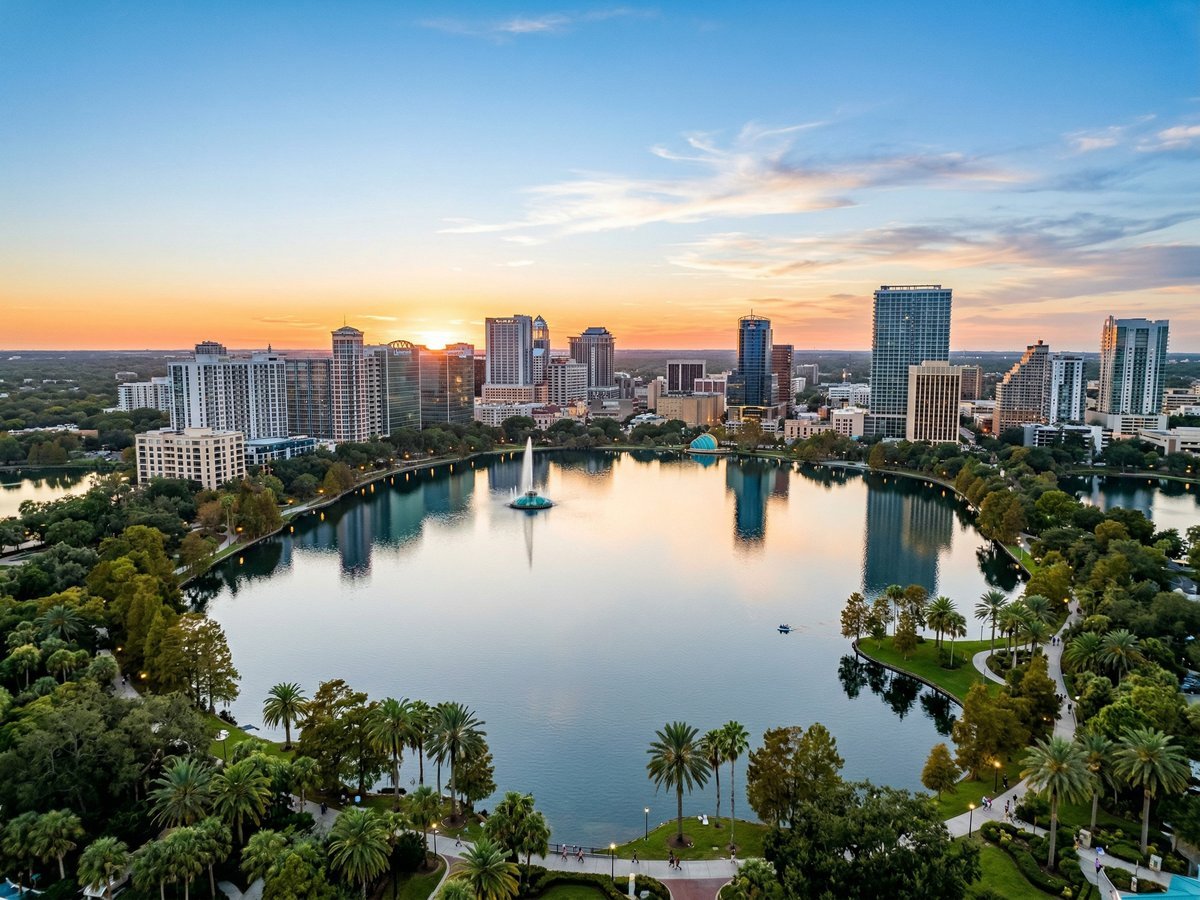
That buys a modern high-rise unit overlooking Lake Eola with access to the Dr. Phillips Center for the Performing Arts, Wall Street Plaza, and a growing dining scene. For context, the median condo price in lower Manhattan exceeds $1.2 million.
Downtown Orlando is still developing its urban core, but the trajectory is clear: new towers, mixed-use projects, and a creative district anchored by EA Sports' Creative Village campus are changing the skyline every year.
Commute to MCO airport: 15 to 20 minutes.
Dr. Phillips = Park Slope for Families
Families who love Park Slope's combination of great schools, neighborhood parks, and walkable dining will find their Orlando equivalent in Dr. Phillips.
Median home price: $570,000 to $660,000 (Redfin June 2025 sales; current listing median). Average sale price: $717,252.
Sand Lake Road, known locally as Restaurant Row, is Orlando's premier dining corridor. You will find everything from upscale sushi to family Italian within a five-minute drive. The schools are strong: Dr. Phillips High School draws families from across Orange County.
Every second house has a pool. Backyards are measured in fractions of an acre, not square feet.
Commute to downtown: 20 to 25 minutes via I-4 or Turkey Lake Road.
Lake Nona = Hudson Yards Energy
If you are drawn to Hudson Yards' new-build energy and mixed-use innovation district feel, Lake Nona is your Orlando neighborhood.
Median home price: $720,000 to $780,000 for the premium sections (Redfin 2025 data). Lake Nona Central, the more accessible section, comes in around $460,000.
Lake Nona is a master-planned community anchored by Medical City: the VA Hospital, Nemours Children's Hospital, UCF's medical campus, and the USTA National Campus. Boxi Park offers container-park dining. The Wave Hotel provides a boutique hospitality anchor. Siemens Energy is relocating its North American headquarters here, bringing nearly 3,000 employees by 2027.
Everything in Lake Nona is new. If you want a home built in the last five years with smart-home features and community amenities, this is where you look.
Commute to MCO airport: 10 to 15 minutes (closest major neighborhood to the airport).
Windermere and Isleworth = Upper East Side Luxury
For buyers in the $1 million to $15 million range, Windermere and its crown jewel Isleworth are Orlando's answer to the Upper East Side and Greenwich, Connecticut.
Windermere median: $690,000 to $900,000 in the broader market. Average list price: $2,080,766 (January 2026).
Isleworth median: $4,000,000. Range: $2 million to $15 million and above.
Isleworth is a gated community on the Butler Chain of Lakes with a private championship golf course, lake-chain boating access, and the kind of privacy that attracts professional athletes and executives. You can watch Disney fireworks from your dock.
Commute to downtown: 20 to 25 minutes in normal traffic.
The Complete Neighborhood Price and Commute Matrix
| Orlando Neighborhood | NYC Equivalent | Median Price | To Downtown | To Disney | To MCO |
|---|---|---|---|---|---|
| Winter Park | Upper West Side | $590K to $619K | 11 min | 33 min | 21 min |
| College Park | Williamsburg | $580K to $600K | 5 to 10 min | 30 min | 20 min |
| Thornton Park | Cobble Hill | $680K to $751K | Adjacent | 35 min | 20 min |
| Downtown | Financial District | $300K (condos) | You are here | 25 min | 15 min |
| Dr. Phillips | Park Slope | $570K to $660K | 20 min | 15 min | 30 min |
| Lake Nona | Hudson Yards | $460K to $780K | 25 min | 25 min | 10 min |
| Windermere | Upper East Side | $690K to $2M+ | 20 min | 15 min | 25 min |
Sources: Redfin, Zillow, NeighborhoodScout, TravelMath, Rome2Rio. Commute times reflect normal (non-rush) conditions.
Cost of Living: Line-Item NYC vs. Orlando Comparison
Orlando is 28% cheaper than New York City excluding rent, and 42% cheaper including rent, according to Numbeo's March 2026 data. Here is what that looks like item by item.
Groceries
| Item | NYC | Orlando | Savings |
|---|---|---|---|
| Dozen eggs | $6.15 | $4.48 | 27% less |
| Gallon of milk | $4.96 | $4.43 | 11% less |
| Chicken breast (1 lb) | $6.98 | $5.51 | 21% less |
| Loaf of bread | $4.20 | $3.49 | 17% less |
| Bottle of wine (mid-range) | $19.99 | $15.00 | 25% less |
Dining and Entertainment
| Item | NYC | Orlando | Savings |
|---|---|---|---|
| Casual restaurant meal | $25 | $20 | 20% less |
| Mid-range dinner for two | $140 | $85 | 39% less |
| Draft beer | $8 | $6 | 25% less |
| Gym membership | $119.79 | $48.67 | 59% less |
Childcare (The Big One)
| Scenario | NYC Monthly | Orlando Monthly | Annual Savings |
|---|---|---|---|
| Infant daycare (full-time) | $2,450 | $1,122 | $15,936 |
| Preschool | $1,850 | $850 | $12,000 |
| Private school (annual) | $59,207 | $21,500 | $37,707 |
Sources: Numbeo.com, Expatistan, Salary.com cost-of-living calculator, Care.com, TooTris Florida childcare report.
The childcare numbers are often the tipping point for families with young children. A family with two kids in daycare saves over $30,000 per year on childcare alone.
What You Need to Know About Orlando Before You Move
You Will Need a Car
There is no subway. SunRail, Orlando's commuter rail, runs limited routes and hours. Lynx buses serve the metro but are not a practical substitute for daily transportation. Budget for at least one car per driving adult. The trade-off: free parking is everywhere, and the commutes listed above are measured in minutes, not hours.
The Weather Is an Adjustment
Summers are hot and humid from June through September. Afternoon thunderstorms are almost daily from May through October. The other seven months are the reason people move here: 70s and 80s, low humidity, sunshine nearly every day. Most New Yorkers find the winter months alone justify the move.
The Job Market Is Expanding
Orlando earned the "Triple Crown" in 2024, ranking first among major metros in job growth, population growth, and nominal GDP growth simultaneously, according to the Orlando Economic Partnership. Major employers expanding in the region include Siemens Energy (Lake Nona HQ), Lockheed Martin, EA Sports, AdventHealth, and the entire tourism and hospitality sector driven by Disney, Universal (including Epic Universe opening), and SeaWorld.
Florida's Homestead Exemption
Florida residents who make a home their primary residence qualify for a homestead exemption that reduces the assessed value of the property by up to $50,000 for property tax purposes. On a $400,000 home, that can save roughly $1,000 to $1,500 per year in property taxes, depending on the county millage rate.
The Population Is Growing Fast: Who Is Moving Here?
Orlando's metro population reached 2,957,672 in 2025, according to U.S. Census Bureau estimates. In 2024, the metro added 75,969 new residents, roughly 1,500 people per week, making it the fastest-growing large metro in the country.
Since the 2020 Census, Orlando has added 284,300 people. That is larger than the entire population of Newark, New Jersey.
International migration accounts for 65% of Orlando's recent growth, with domestic relocation from cities like New York, Miami, and Chicago making up the rest. The transplant community is large enough that some neighborhoods feel like satellite communities of the cities people left behind.
Source: Orlando Economic Partnership, U.S. Census Bureau population estimates, Florida Phoenix census analysis (March 2026).
How to Buy a Home in Orlando: Process Differences from New York
The home-buying process in Florida moves faster and costs less than in New York.
Closing timeline: 30 to 45 days in Florida, compared to 60 to 90 days in New York. No board approvals, no co-op packages, no attorney review period delays.
Closing costs: Florida's documentary stamp tax is 0.7% of the sale price. There is no mansion tax, no flip tax, and no transfer tax at the buyer level on most transactions.
Homestead exemption: File within the first year of purchase to lock in your property tax cap (assessed value increases capped at 3% per year under Florida's Save Our Homes provision).
Title insurance: In Florida, the seller typically pays for the owner's title insurance policy in most counties. This is the opposite of New York convention.
Frequently Asked Questions
Is Orlando cheaper than New York City?
Yes. Orlando is approximately 42% cheaper than New York City when including rent and housing costs, according to Numbeo's March 2026 data. Excluding housing, Orlando is 28% less expensive across categories including groceries, dining, transportation, and childcare.
How much will I save on taxes moving from NYC to Florida?
Florida has no state income tax. A single filer earning $200,000 in New York City pays approximately $18,095 in combined state and city income tax, according to the New York State Department of Taxation and Finance 2025 rate schedule. That entire amount is eliminated by moving to Florida.
What is the median home price in Orlando in 2026?
The Orlando metro median home price is $388,500 as of March 2026, according to the Orlando Regional REALTOR Association (ORRA). Single-family homes have a median of $440,000, while condos sit at $196,500.
What is the best Orlando neighborhood for someone from the Upper West Side?
Winter Park is the closest equivalent to the Upper West Side: tree-lined streets, walkable boutique shopping on Park Avenue, independent restaurants, and SunRail commuter rail access. The median home price is $590,000 to $619,000 per Redfin and Zillow data.
Do I need a car in Orlando?
Yes. Orlando does not have a comprehensive public transit system comparable to the NYC subway. SunRail commuter rail serves a limited north-south corridor. Most residents drive. The upside: commute times are measured in minutes, parking is free nearly everywhere, and average gas prices are below $3.25 per gallon.
How fast is Orlando growing?
Orlando added 75,969 new residents in 2024, making it the fastest-growing large metro in the United States at approximately 1,500 new residents per week. Since the 2020 Census, the metro has added 284,300 people, according to the U.S. Census Bureau and Orlando Economic Partnership.
What is Florida's homestead exemption?
Florida's homestead exemption reduces the assessed value of a primary residence by up to $50,000 for property tax purposes. It also caps annual assessment increases at 3% under the Save Our Homes provision. Residents must file for the exemption within the first year of purchasing their home through their county property appraiser's office.
How long does it take to close on a home in Orlando?
A typical residential closing in Orlando takes 30 to 45 days from accepted offer to closing. This is significantly faster than New York, where closings commonly take 60 to 90 days due to attorney review periods and co-op board approval processes.
What are the best school districts in the Orlando area?
Seminole County is ranked the third-best school district in Florida, according to Niche.com. Within Orange County, Winter Park, Dr. Phillips, and Lake Nona have the highest-rated public school clusters. Private school options include Trinity Preparatory School, The First Academy, and Bishop Moore Catholic High School.
Is Orlando a good place to raise a family?
Orlando consistently ranks among the top metros for families due to affordable housing, strong school options, year-round outdoor activities, and proximity to world-class theme parks. Childcare costs are 54% lower than New York City, according to Care.com data. Neighborhoods like Dr. Phillips, Winter Park, and Lake Nona are particularly popular with relocating families.
What is the commute like in Orlando?
Most Orlando commutes range from 10 to 30 minutes in normal traffic conditions. Rush hour on I-4 (the main east-west interstate corridor) can add 10 to 15 minutes. The trade-off compared to New York: shorter commute times, free parking at your destination, and no subway transfers.
When is the best time to buy a home in Orlando?
Orlando's market typically sees the most inventory in late spring and summer (April through July), giving buyers the widest selection. Fall and winter can offer less competition and more motivated sellers. According to ORRA's March 2026 data, the current market has 4.2 months of inventory, which represents a balanced market that favors neither buyers nor sellers.