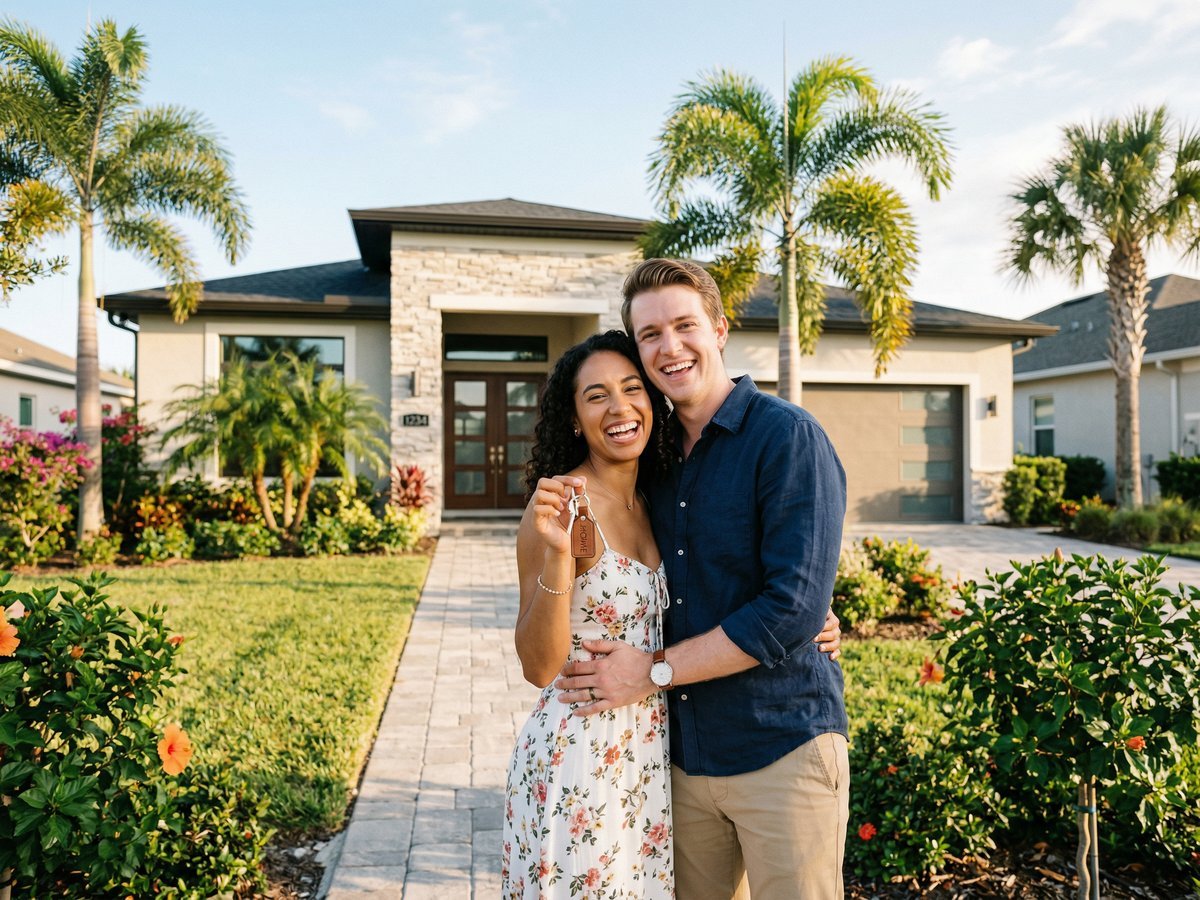
How to Win a Home in Orlando Without Overpaying
The best way to win a home in Orlando without overpaying is to combine a strong pre-approval, strategic offer structure, and the discipline to walk away when the numbers stop making sense. In early 2026, Orlando buyers have more leverage than they have had in years, with home values down 3.8% year over year and median days to pending sitting at 43 days.
That does not mean you can lowball your way to a deal. It means the market rewards prepared buyers who write clean, strategic offers over those who simply throw money at a property. Here is exactly how to position yourself to win without leaving money on the table.
Does Pre-Approval Actually Help You Win Offers?
Yes, and it is non-negotiable. A pre-approval letter tells the seller you have been vetted by a lender, your income and assets check out, and you can close. In a market where 12.4% of sales still close above list price, sellers pay attention to buyer credibility.
But not all pre-approvals are equal. A generic letter from an online lender carries less weight than a full underwrite from a local mortgage company. If you can get fully underwritten before you start writing offers, you move from "probably can close" to "will close." That distinction wins deals, especially when you are competing against two or three other buyers.
Get your pre-approval handled before you tour your first home. Not after you fall in love with a house in Windermere and need to scramble.
How Should You Structure Your Initial Offer Price?
Your offer price should be based on comparable sales within the last 90 days, not the list price. The list price is the seller's wish. The comps are reality.
In early 2026, Orlando's median home value is approximately $370,828, with a median sale price around $372,833. These numbers tell you the market is trading close to assessed values, not wildly above them like it was in 2021 and 2022. That means aggressive overbidding rarely pays off.
Here is a simple framework:
-
If the home is fairly priced based on comps: Offer at or within 1% to 2% of asking
-
If the home is overpriced: Offer at comp value and let the data speak
-
If you expect multiple offers: Consider an escalation clause (more on that below)
For homes in appreciating neighborhoods like Lake Nona or Winter Garden, pricing tight to comps still works because inventory gives you options if this one does not pan out.
What Is an Escalation Clause and When Should You Use One?
An escalation clause automatically increases your offer by a set amount above any competing offer, up to a maximum price you define. It lets you win at the lowest price necessary rather than guessing how high to go.
Example: You offer $420,000 on a home listed at $415,000. Your escalation clause says you will beat any competing offer by $3,000, up to a maximum of $440,000. If the next highest offer is $425,000, your price becomes $428,000, not $440,000. You win without overpaying.
Key rules for escalation clauses:
-
Start with a competitive base offer. A lowball plus an escalation clause insults the seller. Start at or near asking.
-
Use $2,000 to $5,000 increments on homes under $500,000. For luxury properties in Isleworth or Golden Oak, $5,000 to $10,000 increments make more sense.
-
Set your maximum at your true ceiling. The seller will see this number. If you would actually go higher, raise the cap.
-
Require written proof of competing offers. This prevents the seller from fabricating competition to push your price up.
Escalation clauses work best when you know multiple offers are expected. In a quiet, single-offer situation, a clean offer without one is simpler and often preferred by listing agents.
How Much Earnest Money Should You Put Down?
Earnest money (also called a good-faith deposit) signals commitment. In Orlando, the standard range is $5,000 to $10,000 or more, depending on the price point. On a $400,000 home, $5,000 to $7,500 is typical. On a $600,000+ home, $10,000 or more shows you are serious.
More earnest money does not cost you anything extra since it applies to your down payment at closing. But it tells the seller you are less likely to walk away over minor issues.
When to go above the standard range:
-
You are competing against multiple offers
-
The seller has been burned by a previous buyer who backed out
-
You want your offer to stand out without raising the price
A $10,000 earnest money deposit on a $425,000 home grabs attention. It says you are not wasting anyone's time.
Should You Waive the Inspection Contingency?
No. Waiving inspections in Orlando is a bad idea for almost every buyer. Florida homes have specific risks (aging roofs, HVAC strain, polybutylene plumbing, hurricane damage) that you cannot assess from a walkthrough.
What you can do is make your inspection contingency less threatening to the seller:
-
Shorten the inspection period. The Florida standard is 15 days. Offering 7 to 10 days shows urgency.
-
Set a threshold. Tell the seller you will not ask for repairs under a certain dollar amount (e.g., $1,500 or $2,000). This gives them confidence you are not going to nickel and dime them.
-
Schedule inspections immediately. Have your inspector lined up before you submit the offer so you can book within 48 hours of acceptance.
Keeping inspections while making them seller-friendly is the winning move. It protects you without scaring the seller.
Does Closing Flexibility Help Win Offers?
Absolutely. Closing timeline flexibility is one of the most underrated negotiation tools, and it costs you nothing.
Some sellers need a fast close (30 days or less) because they are relocating or buying their next home on a tight timeline. Others need a longer close (45 to 60 days) because they have not found their next place yet. Ask your agent to find out what the seller prefers, then match it in your offer.
If you can close in 30 days or less (especially with full underwriting already done), say so in your offer. Speed gives sellers certainty, and certainty wins deals.
If the seller needs a 60-day close or a rent-back after closing, accommodate it. These concessions cost you very little but can be the deciding factor when two offers are close on price.
Do Personal Letters to Sellers Still Work?
Sometimes. A well-written personal letter can humanize your offer and create an emotional connection with the seller. This is especially effective with long-time homeowners selling the house where they raised their family.
Keep it short, genuine, and focused on the home rather than your life story. Mention something specific about the property that resonated with you. Do not mention protected classes (race, religion, family status) since that creates fair housing issues for the seller.
A letter will not overcome a $20,000 price gap. But when two offers are similar, the personal touch can tip the scales. Your agent can advise whether the seller is likely to respond to it.
When Should You Walk Away From a Deal?
Walking away is a strategy, not a failure. Here is when the math says stop:
-
The appraisal comes in significantly below your offer price and the seller refuses to negotiate. You would be overpaying from day one with negative equity.
-
Inspections reveal major issues (structural, roof, HVAC, plumbing) and the seller refuses to credit or repair. You are buying someone else's problem.
-
You are stretching beyond your budget because of emotional attachment. If the monthly payment makes you uncomfortable, the house is wrong, no matter how much you love it.
-
Comparable homes are available. In 2026, Orlando inventory has grown. If you lose one home in Dr. Phillips, another one is coming. Patience beats desperation every time.
The most expensive home you will ever buy is the one you overpaid for because you were afraid to lose it.
What Is the Best Offer Strategy in Orlando's 2026 Market?
Orlando's 2026 market is buyer-favorable compared to the past few years. With values down, days on market up, and inventory improving, buyers have room to negotiate. The best strategy combines:
-
Full underwriting pre-approval before you tour
-
Comp-based pricing rather than emotional overbidding
-
Escalation clauses when competing against multiple offers
-
Strong earnest money ($5,000 to $10,000+) to show commitment
-
Shortened inspection period (7 to 10 days) without waiving inspections
-
Closing flexibility that matches the seller's needs
-
The discipline to walk away when the numbers stop working
This approach works whether you are buying in Baldwin Park, Celebration, or Reunion. The fundamentals do not change by zip code.
Frequently Asked Questions
How much earnest money should I put down on an Orlando home in 2026?
The typical range is $5,000 to $10,000 or more. On homes under $400,000, $5,000 is standard. On homes above $500,000, $10,000 or more signals serious intent. Earnest money applies toward your down payment at closing, so it is not an additional cost.
Is it a buyer's market in Orlando in 2026?
Yes, conditions in early 2026 favor buyers. Home values are down 3.8% year over year, median days to pending is 43, and inventory is higher than it has been in several years. Buyers have more negotiating power, more choices, and less pressure to overbid.
Should I waive the home inspection to win an offer?
Almost never. Florida homes carry specific risks including aging roofs, HVAC systems under constant stress, and outdated plumbing. Instead of waiving, shorten the inspection period to 7 to 10 days and set a repair-request threshold to show the seller you are reasonable.
What is an escalation clause in real estate?
An escalation clause automatically raises your offer by a set amount above any competing offer, up to a maximum price you choose. It helps you win in a multiple-offer situation without blindly overbidding. You should always require written proof of competing offers before your escalation activates.
How long does it take to close on a home in Orlando?
Most financed purchases close in 30 to 45 days from contract acceptance. Cash purchases can close in 14 to 21 days. If you have full underwriting completed before making your offer, you may be able to close faster than the typical timeline, which gives you a competitive edge.


